
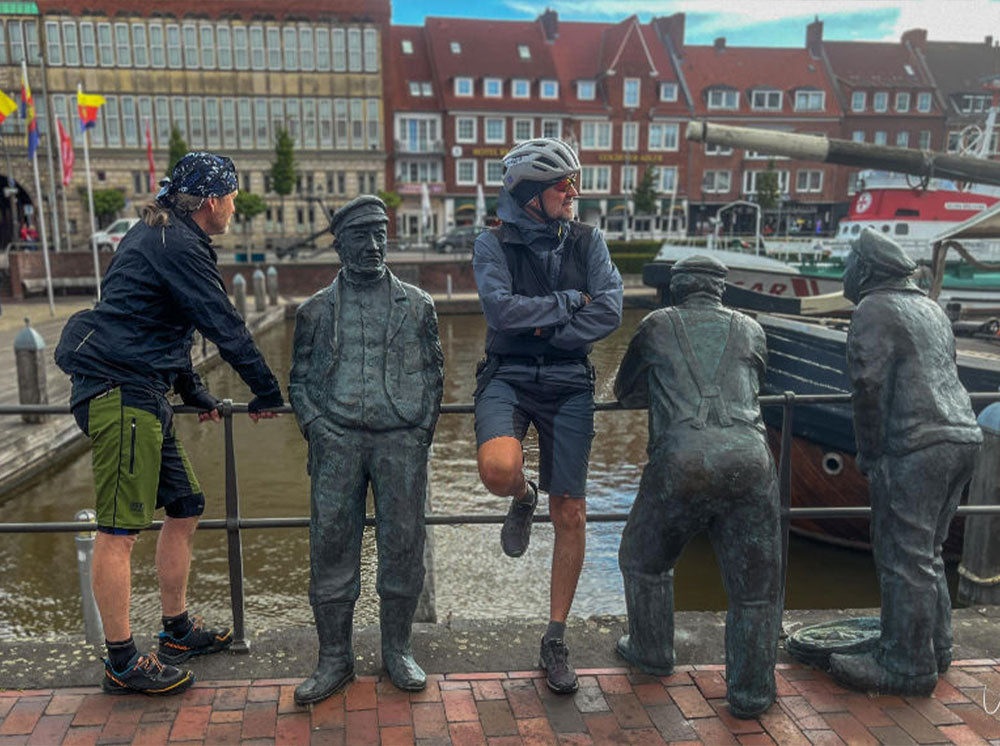
Once to the Saltwater (Front Door – Norderney)
It was quite simple. The cardinal directions were available.
- South – to Rome
- East – to Dubrovnik
- North – to East Frisia
- West – towards France.
A few cups of coffee and two pieces of cake later, the decision was made. We initiated the Go North project. Once across the republic, once up to East Frisia. That sounded like a plan, that was a plan that needed to be refined. That was in January 2025. Today, in June, the project has been successfully completed, and I am happy to take the readers on our beautiful journey through Germany.
A departure is charming when the vacation begins at your doorstep, in this case, Siegsdorf, Upper Bavaria. Our rough idea ("to the north") evolved over the spring into a finely detailed plan, which focused on cycle paths, river courses, but above all, away from federal highways. On the map, this was almost a straight line towards the North Sea. Perfect.
A good 1,100 kilometers, almost 7,000 meters of elevation gain, and 14 cycling days lay ahead of us. Bavaria, Franconia, Hesse, North Rhine-Westphalia, and finally the flat Lower Saxony. We couldn't plan the weather, only pray for it, and I can reveal this much: our prayers were answered.
Bavaria
This should be all too familiar to most (local) readers. Nevertheless, a few words about it. Here the yellow rape grows, here we have lush green meadows, and between it all lie many hills, some more, some less flat. Our planning leads us away from the Alps, but the view back remains possible for a long time. So we make good progress via the beautiful Mühldorf to the impressive Landshut. The Landshut Cathedral, St. Martin's Church, is worth mentioning because, at 130m high, it is the largest brick cathedral in the world (!). Next door, the Landshut Dult is raging, which we leave behind as we push further into Franconia.
Precisely as we entered the hut, heavy rain set in – everything went perfectly. The hut hosts, Maria & Michael, provided us with an almost festive and opulent meal that evening. Three courses and a great atmosphere made our stay truly perfect. Meanwhile, outside, clouds and fog (and diminishing rain) created a natural spectacle providing rich encores. What a fantastic start.
Franconia
Here too, historical buildings await us, first and foremost, Nuremberg Castle. The fact that we cycle past its back forces an obligatory stop. We pedal into the castle courtyard without being stopped and marvel at the impressive walls; the path beyond Erlangen then becomes increasingly gentle, and along the Regnitz, nature belongs to us again. The cities are behind us, now we roam through forests and meadows, ponds and villages. The elevation gains of our approximately 80-90-kilometer daily stages still add up nicely, but compared to the steep mountain passes of the Alps, this has nothing to do with it anymore. Our stop in Bamberg also reveals historical buildings and magnificent structures, especially Bamberg Cathedral, which, with its four imposing towers, is a World Heritage Site.
Hesse
Do you know Hesse? For me, Hesse had previously consisted of Frankfurt and "Appelwoi" (cider), neither of which was beautiful nor tasty. Our journey was supposed to "reorient" me. Hesse is great, Hesse is beautiful, Hesse is worth a (cycling) trip. Along the Fulda, we complete probably the most beautiful part of the journey. Flora and fauna everywhere. Foxes, beavers, herons, and storks. The Fulda flows calmly and gently in natural curves through the floodplains, and – by the way – the sun shines daily, unchanged and unimpressed by our progress. Occasionally, imposing pure white cumulus clouds provide beautiful photo opportunities. A true flood of small to medium-sized towns follows, posing competitively with their half-timbered buildings. Houses built in times when a right angle was not given the importance it is today. Sometimes crooked and warped, but they are still standing and they look incredibly good. Excellent. Fritzlar, Herford (Efze), and many other places along our route would be great excursion destinations in themselves. Anyone planning their tour away from the Alps will automatically cross the Rhön when traversing Germany. And boom, there they are again, the strenuous climbs.
North Rhine-Westphalia
NRW announces itself with a sign, although, strictly speaking, we are in East Westphalia, which sounds a bit meaningless, but it's true. From here, the beauty of Franconia and the Hessian charm leave us, and it seamlessly transitions into a somewhat rougher environment. The buildings become more functional, and one or two pig farms are not very olfactorily convincing either.
Nevertheless, there are things to admire in East Westphalia too. For example, the Externsteine rocks near Detmold are a worthwhile visit for all those who have already seen enough of the (Saxon) Elbe Sandstone Mountains. We also bypass Bielefeld (because Bielefeld doesn't really exist anyway - see Wikipedia), and Osnabrück has never interested me anyway. So, for me, NRW remains the least exciting part of the tour, apart from the fact that we were able to visit a very good old friend from our teenage years here.
Lower Saxony – North Sea
Final sprint. Flat land. One might think that from now on, progress would be quick(er). Not at all. From now on, the Lower Saxon wind blows against us on iron-smooth paths. With wind speeds of sometimes 40 km/h head-on, we struggle to advance meter by meter (and there were still 3x 80km to go). This is not only extremely arduous but above all extremely unpleasant, as you simply don't see your opponent who is blowing and holding you back. Then I'd rather go up the mountains. But no one asks us, and we made the plan ourselves after all. In this part of the country, it is flat and expansive. The winged joke, that you can already see in the morning who will visit in the afternoon, rings true here. Meadows as far as the eye can see. Cows, horses, and isolated farms are the only variety, in addition to the wind.
So we fight our way kilometer by kilometer, finally on the windy dike crest, the goal in sight, but seemingly out of reach in the distance. The fact that we are still well on time (we started one day earlier than planned) allows us to extend the tour and add a cherry on top. We define Norderney as our final destination and spend two wonderful days on this small island.
Conclusion:
our country is colorful and diverse, rich and anything but boring. Hesse was surprisingly great, Lower Saxony wonderfully flat but terribly windy. The nights in the tent were a dream, and the coffee from the gas stove every morning, combined with the self-prepared muesli, was a source of joy. I'll spare you the story of a storm-lashed and rain-beaten night on the North Sea dike, but I will reveal that the morning sky looked kindly down on us again. In that respect, with our East or West, North or South question, we made absolutely the right decision with GoNorth.
© Udo Kewitsch, Jul25, by www.udokah.de / Insta #wwwudokahde